A life of wisdom and service
Sree Narayana Guru
1856–1928 · Kerala, India
Spiritual teacher, poet and social reformer. Sree Narayana Guru brought the search for inner wisdom into the work of building a more equal and compassionate society.
His life invites us to ask a simple question: how can the way we think, learn and live make room for the dignity of every person?
Teachings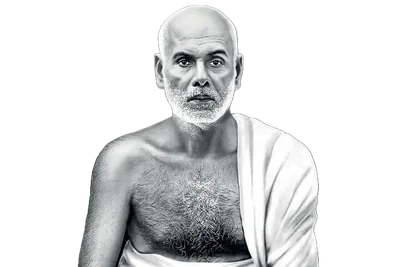
A life rooted in Kerala, open to humanity
Born in Chempazhanthy, near present-day Thiruvananthapuram, in 1856, Narayana Guru grew up amid entrenched caste divisions. His early learning led to teaching, spiritual travel and contemplation. He became known for bringing philosophical insight into everyday social life.
Sivagiri in Varkala became an important centre of his work. He died there in 1928. Understanding this Kerala setting helps us appreciate the courage behind his message: human worth could not be measured by birth or social rank.
Wisdom expressed in the way we live
Guru’s philosophy is associated with Advaita, or non-duality. In an introductory reading, this means looking beyond apparent separateness toward an underlying unity. His social vision placed human equality beside spiritual inquiry. The following themes are explanatory summaries, not direct quotations.
- Equal dignity
- Caste, religion and inherited status should not determine a person’s worth. This outlook challenges us to examine the everyday ways we include or exclude others, as well as the larger institutions we share.
- Compassion in action
- Concern for another person’s well-being gives ethical life its substance. A useful way to approach this teaching is to consider the effects of our choices on those who have less power or fewer opportunities.
- Learning and self-inquiry
- Education and reflection help people grow in understanding. Learning can mean acquiring practical skills, questioning prejudice, or examining our own assumptions with patience and honesty.
- Respect across religions
- Guru encouraged understanding between faiths and attention to the quality of a person’s conduct. His invitation to dialogue offers a way to meet difference with curiosity and care.
Spiritual insight, practical change
Guru’s contributions took shape in places where people worshipped, learned and organized. They joined a demand for dignity with practical opportunities for communities to develop confidence and independence.
- Worship and equality
- His consecration of a Shiva shrine at Aruvippuram in 1888 challenged caste-based restrictions on religious authority. In a society where access to sacred spaces was unequal, the act gave spiritual expression to the dignity of excluded communities.
- Education and collective effort
- Guru’s guidance helped shape the Sree Narayana Dharma Paripalana (SNDP) Yogam, established in 1903. Education and organization were central to its work for social advancement. This connected individual learning with the capacity of people to improve their shared circumstances.
- Dialogue between faiths
- The all-religion conference at Aluva in 1924 encouraged mutual understanding. Bringing different traditions into conversation gave public form to the idea that religious encounter could be a shared search for understanding.
- Knowledge for everyday life
- His guidance for the Sivagiri pilgrimage joined spiritual practice with education, cleanliness, agriculture, trade, crafts and technical training. The intention was that people would learn from knowledgeable speakers and use that learning to improve life in their communities.
A teacher whose words still invite reflection
Guru wrote in Malayalam, Sanskrit and Tamil. His works include devotional poetry and philosophical inquiry. These three works offer different ways to begin reading him; the brief descriptions below are introductions rather than translations.
- Daivadaśakam
- A prayer of ten verses in Malayalam, composed for young students. It moves from an appeal for divine care toward a deeper understanding of the relationship between the self and the divine. The prayer reader on this site includes the original, Roman transliteration and introductory English reading notes.
- Atmopadesa Satakam
- One hundred verses of self-instruction in Malayalam. The work invites reflection on self-knowledge and the relationship between our own experience and a shared reality. It rewards slow reading: a single verse can become the starting point for contemplation and discussion.
- Darsana Mala
- A philosophical work in Sanskrit arranged around ten visions of reality. It explores questions of knowledge, experience and spiritual understanding. Readers new to Indian philosophy may find a commentary helpful; Narayana Gurukula’s introduction below provides a starting point.
A message we can carry into the world
Guru travelled beyond Kerala, including visits to Sri Lanka. His writings also continue to be studied through translations and commentaries. This documented reach is one aspect of his legacy; another is the opportunity each generation has to reflect on his ideas in its own circumstances.
The suggestions here are present-day reflections inspired by his teachings, not claims that Guru addressed every modern issue. Equality can begin with noticing who is missing from a conversation. Interfaith respect can begin by listening to someone explain their own tradition. Compassion can begin with a practical act of care.
For a family, these ideas might mean giving children room to ask questions without passing on inherited prejudice. For a community, they might mean sharing educational resources or making gatherings welcoming to people of different backgrounds. For each of us, they can mean bringing greater honesty and kindness into ordinary decisions.
The global Daivadaśakam recitation offers one occasion for this reflection. Reading together can become a starting point for thinking about how peace and fellowship take shape in everyday life, beyond the moment of prayer itself.
Begin with the prayer. Keep exploring.
Read Daivadaśakam at your own pace, then return to the teachings and works that interest you. The sources below offer institutional biographies, historical background and introductions to published commentaries.
Read DaivadaśakamSources and further reading
- Kerala Tourism · Life of Sree Narayana Guru
- Kerala Tourism · Philosophy
- Sivagiri Mutt · Biography and teachings
- Kerala Tourism · Aruvippuram consecration
- Kerala Tourism · Interfaith understanding
- Sivagiri Mutt · Purpose of the pilgrimage
- Kerala Tourism · Literary works
- Narayana Gurukula · Daiva Dasakam commentary
- Narayana Gurukula · The Psychology of Darsana Mala
This page is an original introductory summary, not a translation of Guru’s writings. Interpretations are distinguished from historical events. The linked sources are in English; published commentaries remain the work of their respective authors.